

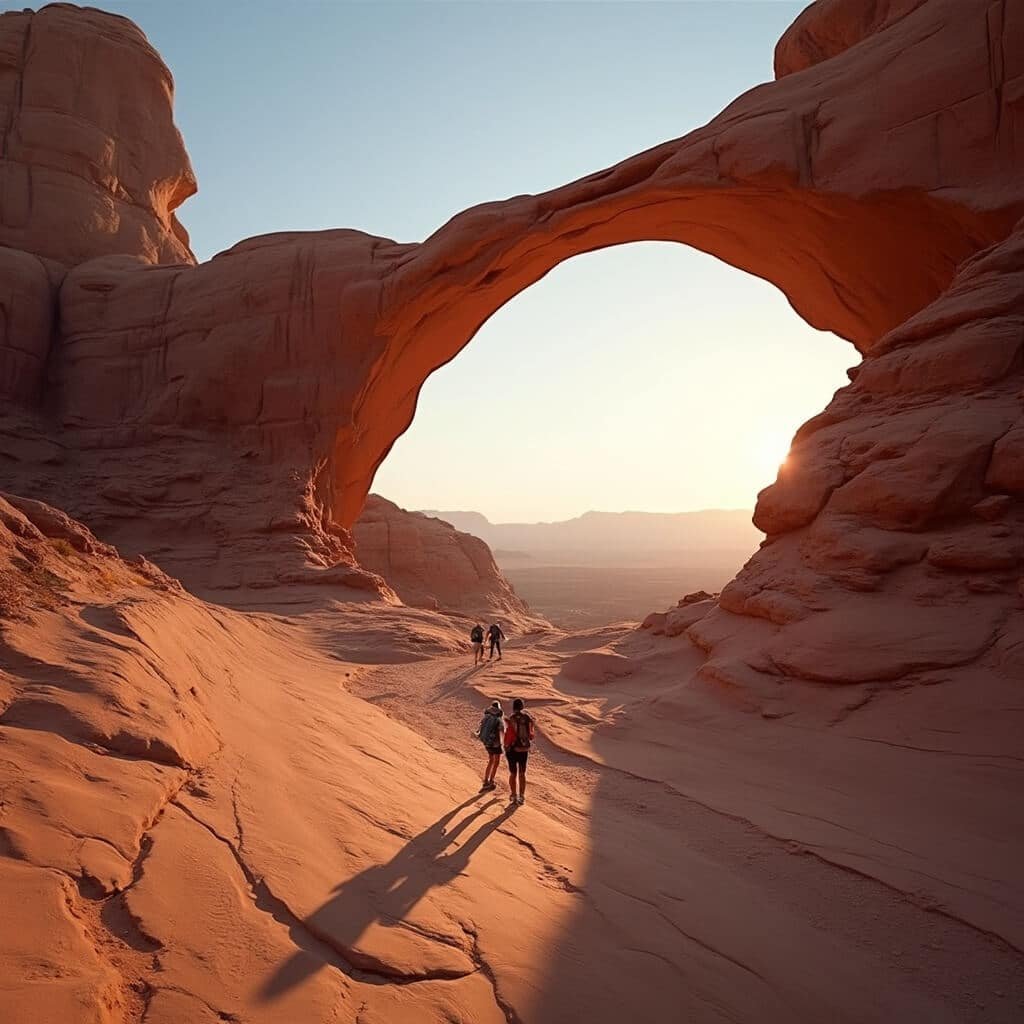
Devil’s Garden sits at the far northern end of Arches National Park, about 18 miles from the visitor centre — roughly a 45-minute drive if the road’s behaving itself. I say “if” because this is Arches in high season we’re talking about, and the road rarely just behaves. This is the trail system most people picture when they imagine Arches: fins of orange sandstone standing like the backs of half-buried whales, slickrock underfoot, and more named arches packed into one hike than anywhere else in the park.
It’s worth saying upfront that “Devil’s Garden Trail” isn’t really one trail. It’s a network, and the experience changes dramatically depending on how far you go. The walk out to Landscape Arch is gentle enough for most people in trainers. Beyond that, it turns into genuine scrambling, with the so-called Primitive Trail at the far end being the hardest stretch in the entire park. I’ve watched people set off from the car park assuming it’s all one easy stroll, only to turn back sweaty and rattled an hour later. Knowing which version of the hike you’re signing up for matters more here than almost anywhere else in Arches.
Why hike Devil’s Garden
The headline attraction is Landscape Arch, and it earns the hype. Its opening spans roughly 306 feet, making it one of the longest natural stone spans anywhere — and it looks improbably thin for something that size. In the 1990s, large slabs sheared off the underside, which is a useful reminder that these formations aren’t static monuments. They’re actively falling apart, slowly, in a process that’s been going on for millions of years and will keep going long after we’ve all gone home.
Beyond Landscape Arch, the trail strings together an unusual number of formations for a single outing: Pine Tree Arch, Tunnel Arch, Navajo Arch, Partition Arch, Double O Arch, the dark spire known as Dark Angel, and the quieter Private Arch tucked off to one side. No other trail in the park gives you this much variety in one go — you walk from an easy, family-friendly path into proper desert scrambling, past fins and overlooks, with the terrain and the difficulty both ramping up the further you commit.
It also works well as more than just a hike. There’s a campground right there if you want to turn it into an overnight stay, dark skies worth lingering for, and enough photogenic rock to keep anyone with a camera busy for hours.
Who this hike suits
Honestly, almost everyone — just not all on the same route. First-time visitors wanting a short, scenic walk can get Landscape Arch and be back at the car within an hour or two. Families with young kids tend to do well on that same stretch. Experienced hikers after scrambling and a bit of exposure should push on to Double O Arch and beyond. Photographers will find something worth shooting at nearly every stage, and anyone planning to camp at Devils Garden Campground will want to know how the trail connects to their site. If you need specifics on accessibility or terrain before committing, that’s covered further down — it’s not a simple yes-or-no answer.
Essential trip facts before you go
Devil’s Garden trailhead is at the literal end of the main park road — you can’t get lost finding it, there’s nowhere else to turn. The road itself is paved and easy, but the car park is small relative to how many people want to use it. During spring, autumn weekends, and holidays, it fills up. The National Park Service is explicit that you shouldn’t park on vegetation or block the road if that happens, which sounds obvious but I’ve seen it ignored constantly.
Give yourself extra time at the entrance gate too. Between March and October, entrance queues have been known to run past an hour, and that’s before you’ve even reached the trailhead car park. Checking the park’s webcam or current conditions page before leaving your accommodation is a five-minute job that can save you a frustrating morning.
As of 2026, advanced timed-entry reservations aren’t required to get into the park — you just need a valid entrance pass and to come during operating hours. That said, staff can and do temporarily redirect traffic if things get congested at the gate or trailhead, so turning up early or later in the day still pays off. Don’t confuse this general entry policy with the separate reservation systems still in place for Devils Garden Campground or for Fiery Furnace hikes — those are booked independently and won’t be solved by having a park pass in hand.
Best time of day and year to go
Spring and autumn are the sweet spot, with daytime highs typically sitting somewhere between 60 and 80°F and nights dropping to 30–50°F — cool enough for a jumper at the campground, warm enough for a daytime walk in a t-shirt. Summer is a different story. Midday temperatures regularly crest 100°F, and the exposed sandstone sections of this trail offer precisely no shade. I wouldn’t attempt anything beyond Landscape Arch in the early afternoon in July.
An early start solves most problems at once: it’s cooler, the light is better for photos, and you’ve got a decent shot at finding a parking space before the overflow starts. I’d be cautious about a late-afternoon start unless you’re sticking to the easy section — the Primitive Trail involves genuine route-finding, and you don’t want to be squinting for cairns as the light goes. I made that mistake once near Double O Arch, misjudging how long the scrambling sections would take and ending up jogging the last mile back as the sky turned that deep orange that looks lovely in photos and considerably less lovely when you’re the one still on the trail.
Choosing the right route for you
Landscape Arch — the easy, essential walk
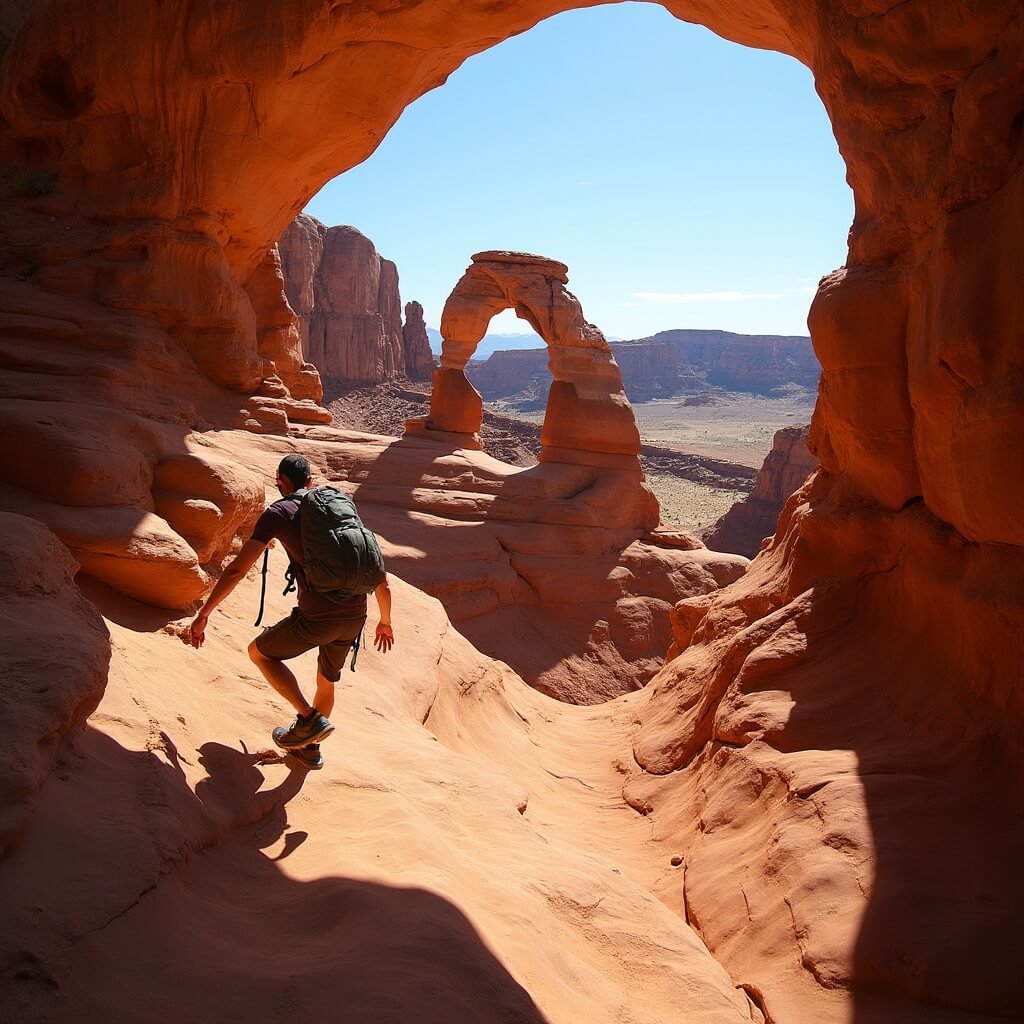
This is the one almost everyone should do, regardless of fitness or experience. It’s 1.9 miles round trip, rated easy, on a surface that’s mostly hard-packed or graveled with some gentle rolling hills but no real elevation gain. You walk between tall fins, the view opens up, and there’s the arch — impossibly long, impossibly thin, just sitting there having survived for who knows how many thousands of years.
This is also the key decision point for the whole hike. Everything past Landscape Arch gets noticeably harder, with scrambling, narrow ledges, and exposure. If you’ve got small children, dodgy knees, or simply fancy a short scenic walk rather than an adventure, turn around here. There’s no shame in it — it’s arguably the best short hike in the entire park.
Pine Tree Arch and Tunnel Arch — easy detours worth taking
These two add about half a mile round trip combined, and they’re both gentle enough to tack onto the Landscape Arch walk without much extra effort. Pine Tree Arch gives you a framed view through a decent-sized opening, while Tunnel Arch sits recessed among the rock in a way that feels more secluded. Neither will test you physically. I’d do both on the way out or back from Landscape Arch rather than treating them as a separate trip — they’re close enough that skipping them feels like a waste.
These sit between Landscape Arch and Double O Arch, adding roughly 0.8 mile combined, but getting to them means you’re already on the harder section of trail. Navajo Arch feels tucked away, almost like a natural room carved into the rock, while Partition Arch frames long views out over the fins and desert beyond. Expect uneven ground and some scrambling to reach them — this isn’t the gentle gravel path you were on half a mile earlier.
Double O Arch — the real test
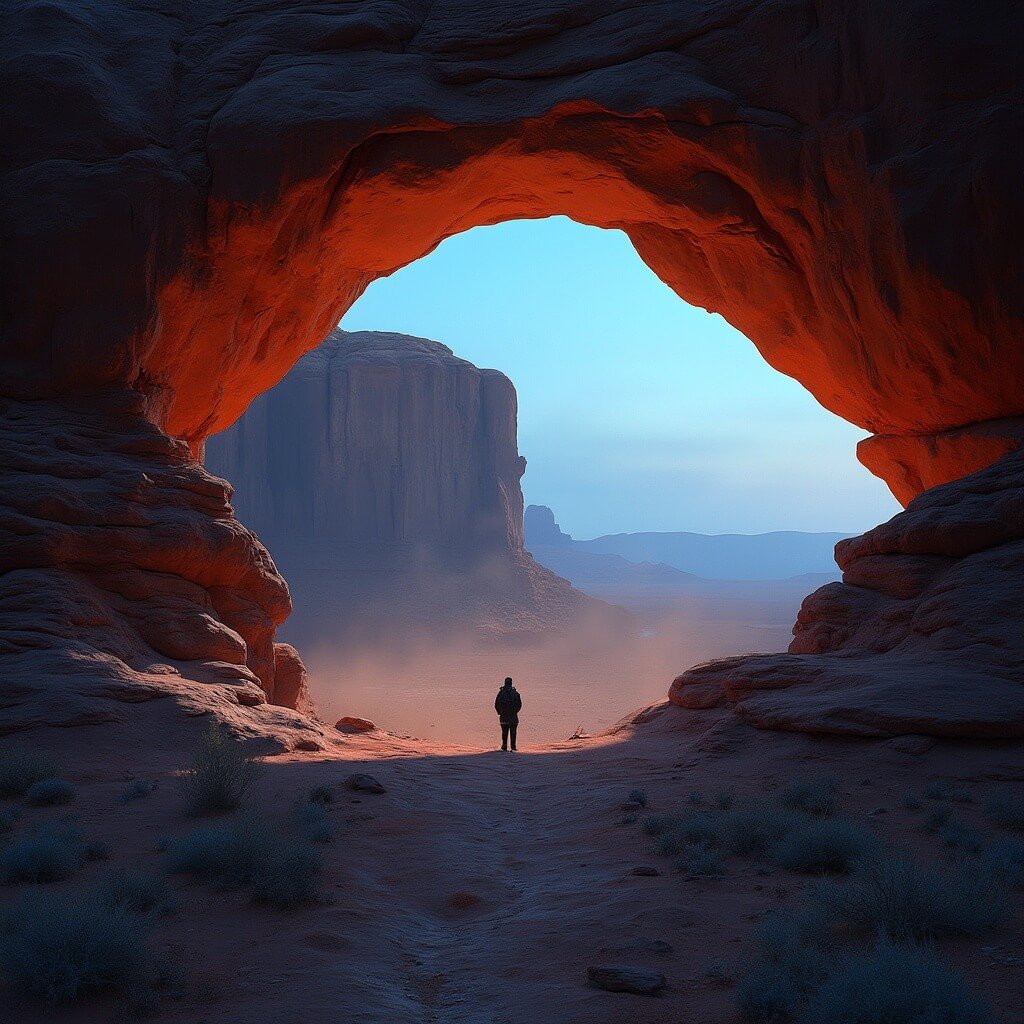
At 4.1 miles round trip and rated difficult, this is where the hike properly earns its reputation. You’re dealing with steep climbs over bare sandstone, rocky footing, narrow ledges with real drop-offs, and sections where you’ll be using hands as well as feet. The reward is worth it: Double O Arch is actually two openings stacked one above the other, and the views along the way are some of the best in the park.
This section isn’t for everyone, and that’s fine. If you’re reasonably fit, don’t have a serious fear of heights, and you’re wearing shoes with actual grip, you’ll likely be fine. If you’re exhausted, the rock’s wet, or exposure makes your stomach drop, this is where you turn back — no route beyond here gets any easier.
For more outdoor adventures, consider exploring the nearby trails: Walk Among the Bristlecone Pines in Nevada and Discover Valley of Fire State Park in Nevada.
👇Find The Cheapest Flights To Anywhere Here👇
Dark Angel — a worthwhile detour if you’ve got the legs
Dark Angel adds up to 4.9 miles round trip via the main trail, with the spur peeling off near Double O Arch. It’s a tall, dark spire of sandstone, striking against the paler rock around it, and visible well before you reach its base. The thing to understand is that this isn’t a quick add-on — by the time you’re considering it, you’ve already done the hardest climbing of the day, and this tacks on more distance and more time on tired legs. Make sure you’ve still got water, food, and daylight in reserve before committing. If the group’s flagging, skip it — you can always come back another trip.
Save this article
Enter your email and we'll send it straight to your inbox.
The Primitive Trail — not a suggestion to take lightly
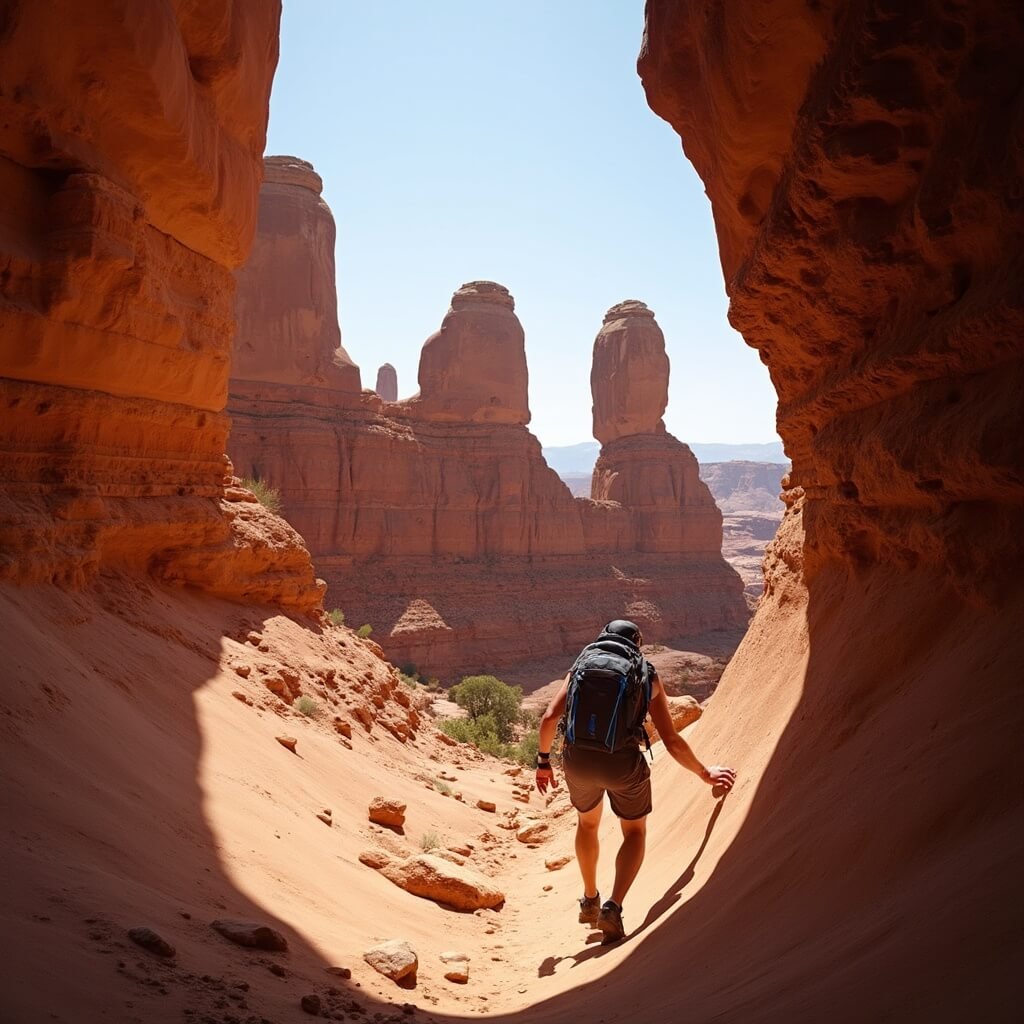
This is the one section of Devil’s Garden that genuinely deserves its “most difficult” label. As an alternative route back from Double O Arch, it runs about 2.1 miles one way, and it throws nearly everything at you: steep slopes, narrow drop-offs, sections of rock scrambling, deep sand that saps your pace, and a pool that may or may not hold water depending on recent rain. Route-finding is a real skill here, not a formality — the trail relies on cairns rather than a clearly worn path in places, and wandering off in the wrong direction is easy to do.
The National Park Service is blunt about this, and so am I: don’t build new cairns, don’t take what looks like a shortcut, and if you do lose the route, stay where you are and wait rather than pushing on and hoping it resolves itself. I’d suggest only attempting the Primitive Trail if the rock is completely dry, your group is comfortable with heights, and everyone’s up for a proper adventure rather than a scenic stroll. Snow, ice, or heavy rain are all good reasons to stick to the main trail both ways instead — there’s no prize for taking the harder route if conditions have turned against you.
Private Arch — the quiet one at the end
Tucked off near the Double O/Primitive Trail junction, Private Arch sits about 0.42 miles from that point, with the spur itself adding around 0.52 miles round trip. It’s easily the least visited arch on the whole system, which is rather the point — if you’ve made it this far and still have daylight, water, and energy to spare, it’s a peaceful spot to finish on before heading back.
Working out distances and building an itinerary
Here’s how the current National Park Service figures break down, which is worth bookmarking before you set off:
| Destination or route | Round-trip distance |
|---|---|
| Landscape Arch | 1.9 miles / 3.1 km |
| Pine Tree and Tunnel Arch side trails | Add 0.5 mile / 0.8 km |
| Double O Arch | 4.1 miles / 6.6 km |
| Navajo and Partition Arch side trails | Add 0.8 mile / 1.3 km |
| Dark Angel via main trail | 4.9 miles / 7.9 km |
| Dark Angel returning via Primitive Trail | 6.6 miles / 10.6 km |
| All trails and spurs | 7.9 miles / 12.6 km |
For a one- to two-hour outing, stick with Landscape Arch and, if you’ve still got energy, the Pine Tree and Tunnel Arch spurs — just turn around before the terrain changes under your feet. For a half-day moderate hike, I’d suggest Landscape Arch, Navajo Arch, Partition Arch, and Double O Arch, returning the way you came on the main trail rather than risking the Primitive Trail on a first attempt. If you want the full strenuous version, add Dark Angel to that list and still come back via the main trail. The full-day advanced itinerary — everything, including the Primitive Trail loop and Private Arch — is for people who’ve genuinely planned for it: enough water, a dry-weather forecast, and no illusions about how tired they’ll be by the final mile.
Whatever itinerary you pick, there are natural decision points built into the trail itself. At the Landscape Arch junction, you’re deciding whether the group’s ready for difficult terrain at all. Near the Navajo and Partition spurs, it’s worth a quick gut check on weather, fatigue, and how much daylight you’ve got left. At Double O Arch, you’re choosing whether to push on to Dark Angel and whether the Primitive Trail is realistic today. None of these decisions need to be made before you leave the car — in fact, I’d argue it’s better to make them in real-time, based on how everyone’s actually feeling rather than how ambitious you felt at breakfast.
Trail conditions and getting around safely
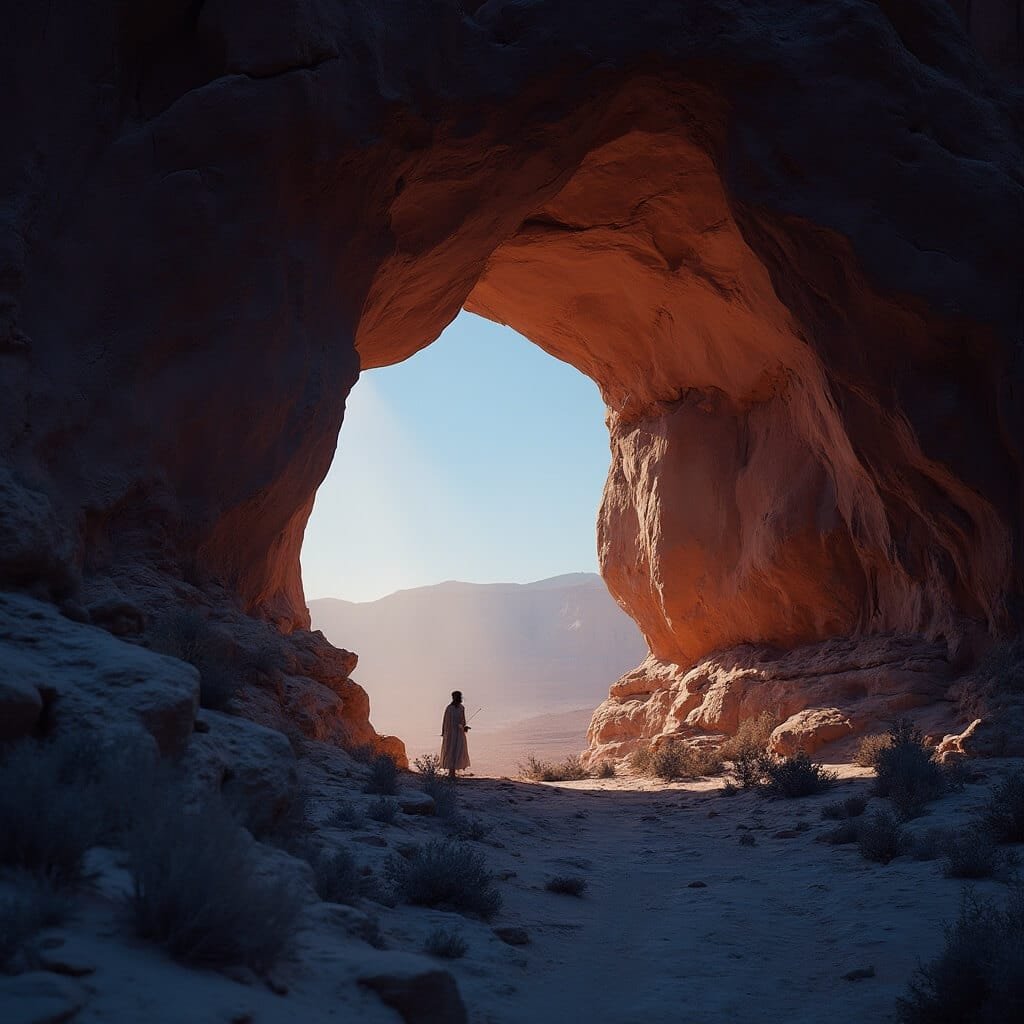
The lower section — the Landscape Arch stretch — is hard-packed or graveled, with gentle grades and the odd rolling hill but nothing that counts as real elevation gain. Past that, you’re on bare bedrock and sandstone, with steep climbs, narrow ledges, and exposure that wasn’t there a few hundred meters back. The Primitive Trail adds deep sand, rock steps, and the occasional water crossing on top of all that.
It’s worth being honest about accessibility here, because the “easy” label on Landscape Arch can be misleading. That section is genuinely the most approachable part of the system — hard-packed surface, no major elevation gain — but the rest of Devil’s Garden has real barriers: rock steps, steep grades, narrow tread, deep sand, uneven bedrock. The Park Service’s own accessibility pages break down grades, cross slopes, and tread widths in detail, and I’d read that properly rather than assuming “easy” means the whole trail system is open to you. If you’re using a mobility device, it’s worth a quick conversation with park staff on arrival — conditions change with weather and maintenance, and what was fine last month might not be now.
Beyond that, the usual desert navigation rules apply: stick to established trails and existing cairns, don’t build new ones, and download your maps before you lose signal, which happens fast out here. Keep your group together once the terrain gets confusing, and if conditions are deteriorating — light fading, weather turning, people flagging — turn around earlier than feels strictly necessary. You’ll rarely regret an early turnaround. You will absolutely regret a late one.
Safety, heat, and looking after the desert
Water is the single biggest factor in how your day goes. The Park Service recommends at least a gallon per person per day as a general guideline for Arches, and on the Devil’s Garden system — much of it with zero shade — that’s not an exaggeration. Pair it with salty snacks, start early, and take breaks in whatever shade you can find, which on the upper trail is sometimes none at all. Headache, dizziness, nausea, confusion, and unusual fatigue are all signs to stop and reassess, not push through.
Exposure is the other serious risk. Narrow ledges and sandstone fins aren’t the place for running or messing about, and smooth-soled shoes have no business being anywhere near the scrambling sections. Keep kids close wherever there’s real drop-off, and never, under any circumstances, climb onto the arches themselves — they’re fragile, it’s against the rules, and it’s exactly the kind of thing that leads to another Landscape Arch-style collapse.
Weather can turn an easy day into a genuinely dangerous one. Wet sandstone gets slippery fast, ice can hide trail markers completely, and flash flooding is a real risk around washes and low pools after storms. If there’s any doubt about conditions, recheck the forecast before setting off, and don’t attempt the Primitive Trail if there’s been recent rain or snow.
The desert itself needs looking after too. That dark, crusty-looking soil you’ll see off the trail isn’t just dirt — it’s biological soil crust, a living mix of cyanobacteria, lichens, and fungi that stabilizes the ground and took decades to form. One careless footstep can undo that in a second, and it won’t recover in your lifetime. Stay on the trail, pack out everything you bring in, and leave rocks and plants exactly where you found them.
What to pack
Beyond the obvious — water, sturdy shoes with grip, sun protection, and layers for the temperature swing between morning and midday — a few things make a real difference on this particular trail. Trekking poles help enormously on the Primitive Trail‘s loose sand and uneven steps, and if there’s been any snow or ice, traction devices aren’t optional extras, they’re the difference between a hike and an incident. A headlamp is worth carrying even if you’re not planning to be out at dawn or dusk, because plans change and daylight disappears faster than you expect once you’re deep in the scrambling sections.
If you’re bringing a camera, a wide-angle lens covers most of the arches and fins nicely, while something with a bit of reach is useful for Dark Angel, which you’ll mostly be viewing from a distance. Sand gets everywhere out here, so a lens cloth earns its keep.
Families should factor in extra snacks and water beyond what adults alone would need, plus a clear, agreed turnaround point before setting off — kids tire unevenly and suddenly, and it’s much easier to have that conversation in the car park than halfway up a sandstone fin. Older hikers or anyone less steady on loose rock will get real value from poles and a conservative route choice; there’s no trophy for attempting Double O Arch on a day your knees are telling you otherwise.
My honest recommendation: do Landscape Arch regardless of your fitness or plans, because it’s simply one of the best short walks in the entire park, and then make an honest, unsentimental assessment of your group before deciding whether to continue. Devil’s Garden rewards ambition, but only when it’s matched with decent shoes, enough water, and a willingness to turn back the moment conditions or energy say you should.
👇Ready To Book Your Trip?👇
This post may contain affiliate links. Please see my disclosure policy for details.
Want to keep this one?
We'll email you the link so you can find it again later.