
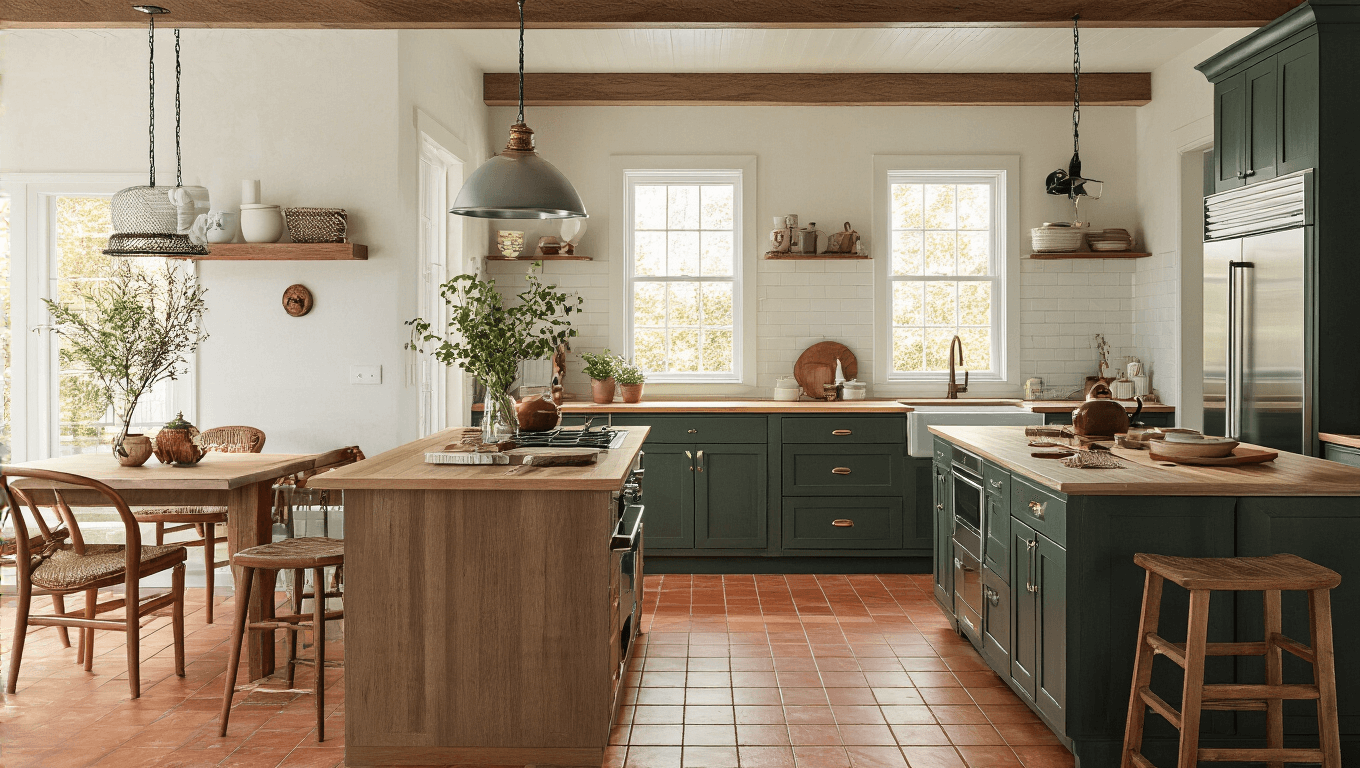
Kitchen Flooring Ideas That Actually Work
Kitchen flooring ideas matter more than you think, and I’m telling you this after watching my beautiful but completely impractical hardwood floor warp near the dishwasher three years ago.
You’re standing in your kitchen right now, aren’t you? Maybe staring at that cracked tile or that vinyl that’s peeling at the corners. Or maybe you’re building new and terrified of making an expensive mistake.
I get it. Your kitchen floor takes more abuse than any other surface in your home. Spills, dropped pots, the dog’s water bowl, that time you forgot the pasta was boiling over.
Let me walk you through what actually works.

🎨 Steal This Look
- Paint Color: Sherwin-Williams Pure White SW 7005
- Furniture: freestanding kitchen island with butcher block top on locking casters
- Lighting: schoolhouse pendant lights in aged brass finish
- Materials: large-format porcelain tile with subtle concrete texture, natural cork underlayment, matte black metal accents
I learned this the hard way after my ‘waterproof’ laminate bubbled within eighteen months, and now I only specify materials I’ve personally stress-tested with red wine, olive oil, and a dropped cast-iron skillet.
The Heavyweights: Floors That Refuse to Quit
Porcelain Tile Is the Gordon Ramsay of Kitchen Floors
Listen, porcelain tile flooring doesn’t mess around.
This stuff absorbs less than 0.5% water. That means when your teenager knocks over an entire gallon of juice (true story), you’re not panicking about floor damage.
Here’s why I’m obsessed:
- Lasts 25-30 years even in kitchens that see more action than a restaurant
- Scratches? My dog’s nails haven’t made a dent
- Comes in wood looks, stone looks, concrete looks—basically anything you’re dreaming of
- Handles the temperature swings when you’re pulling something from a 450-degree oven
The catch? It’s cold and hard underfoot. If you’re someone who stands cooking for hours (hello, Sunday meal prep), your feet will remind you.

Luxury Vinyl: The Underdog That Won Me Over
I used to turn my nose up at vinyl. Then I installed luxury vinyl plank flooring in my last kitchen renovation.
Game. Changed.
Modern LVT and LVP are nothing like the vinyl your grandmother had:
- Nearly 100% waterproof—not water-resistant, actually waterproof
- Softer underfoot than tile (your back will thank you)
- Realistic wood and stone looks that fool most visitors
- Costs less than hardwood but lasts 15-20 years
- Warmer to stand on during those early morning coffee moments
I spilled an entire pot of spaghetti sauce once. Just wiped it up. No staining, no sealing, no drama.
💡 Steal This Look
- Paint Color: Benjamin Moore Chantilly Lace OC-65
- Furniture: open shelving unit in white oak with brass brackets
- Lighting: schoolhouse pendant with matte black canopy
- Materials: matte porcelain tile with rectified edges, unlacquered brass hardware, honed Carrara marble countertop
I installed porcelain wood-look tile in my own kitchen five years ago, and after two kids, a dog, and countless dropped cast iron pans, I still haven’t found a single chip—though I definitely invested in cushioned kitchen mats for my prep zones.
The Strong Supporting Cast
Ceramic Tile: Porcelain’s More Affordable Cousin
Ceramic tile runs about $2-6 per square foot.
It’s less dense than porcelain, sure. But for most home kitchens? Completely adequate.
The bonus: if you crack a tile, replacing individual pieces is easier than with porcelain.

Natural Stone When You Want to Show Off
Granite, slate, quartzite—these floors can outlive your house.
I’ve walked on 200-year-old stone kitchen floors in Europe that still look incredible.
Save this article
Enter your email and we'll send it straight to your inbox.
What they don’t tell you:
- Requires sealing (sometimes annually)
- Each stone piece is unique, which sounds romantic until you’re trying to match replacements
- Cold and hard like tile
- Can be slippery when wet
- Expensive upfront but think of it as a one-time investment
If you go this route, invest in quality stone sealer and actually use it.
Engineered Hardwood: For the Wood Lovers
I love real wood. But solid hardwood in kitchens? That’s asking for trouble.
Engineered hardwood is the compromise that actually works.
It’s real wood on top with a stable core underneath that handles moisture better. Lasts 15-25 years if you’re not constantly flooding it.
Critical rules:
- Wipe up spills immediately (not in five minutes, NOW)
- Use rugs near the sink
- Refinish every 7-10 years
- Accept that it will show wear

Laminate: The Budget Option That’s Better Than It Used to Be
Laminate costs $2-5 per square foot and has improved dramatically.
But here’s the truth: if you can afford vinyl plank instead, get vinyl plank.
Laminate’s core is fiberboard. Water gets in, it swells. I’ve seen it happen, and it’s not pretty.
That said, if budget is tight, modern laminate flooring with proper installation will give you 10-15 years.

Bamboo: The Eco-Friendly Dark Horse
Bamboo is technically grass, not wood. It’s harder and more water-resistant than most hardwoods.
Get strand-woven bamboo specifically. The regular stuff won’t cut it in a kitchen.
It’s sustainable, looks beautiful, and performs better than you’d expect. Just seal it properly and treat it like you would engineered hardwood.

★ Steal This Look
- Paint Color: Farrow & Ball De Nimes 299
- Furniture: farmhouse-style oak kitchen island with turned legs
- Lighting: vintage brass schoolhouse pendant over prep area
- Materials: tumbled travertine, hand-glazed ceramic, unsealed slate, butcher block accents
I always tell clients that ceramic tile is the unsung hero of busy family kitchens—it’s the flooring equivalent of that reliable friend who shows up, doesn’t demand attention, and never lets you down when sauce hits the floor.
What Actually Matters When You’re Choosing
Let me break this down the way I wish someone had for me:
If Durability Tops Everything
Go porcelain or natural stone. Yes, it’s expensive. Yes, it’s hard underfoot. But you’ll install it once and forget about it for decades.
If Water Is Your Enemy
You have kids who spill
This post may contain affiliate links. Please see my disclosure policy for details.
Want to keep this one?
We'll email you the link so you can find it again later.